By Mariatou Ngum & Abdou Mbye
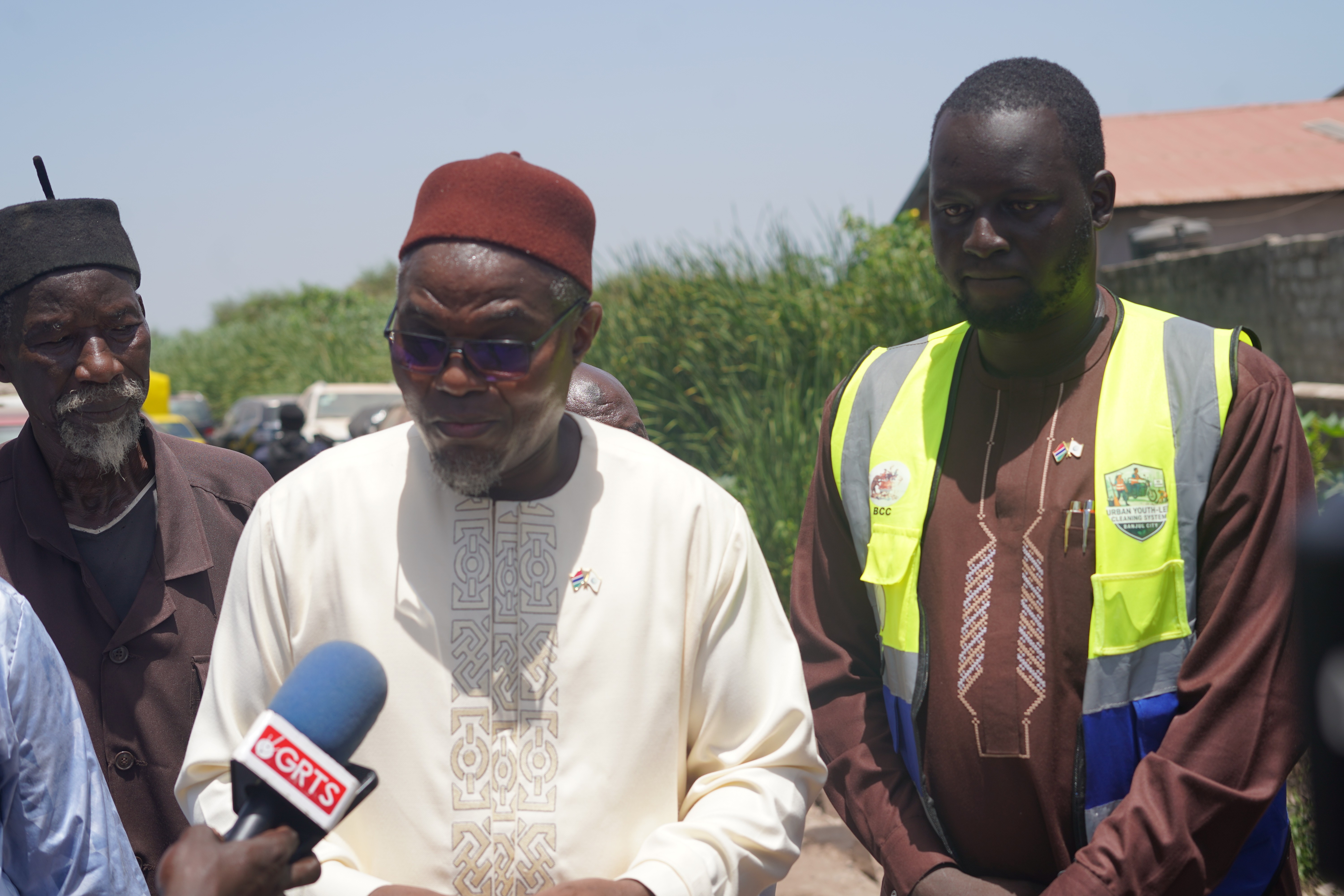
In a proactive move to safeguard the capital city from potential flooding during the upcoming rainy season, His Excellency Vice President Mohammed B.S. Jallow on Tuesday, 16 June conducted an emergency inspection tour of key drainage channels in Banjul, with a particular focus on the Grand Street drainage corridor and Tobacco Road.
The unannounced visit followed reports of indiscriminate waste dumping into critical drainage systems, raising concerns about the risk of flooding in the city if urgent action is not taken.
Speaking after the inspection, Vice President Jallow revealed that he received information about the situation the previous night, prompting immediate intervention.
“This was an emergency that required urgent attention,” the Vice President said. “I instructed relevant stakeholders, including the Banjul City Council, the National Disaster Management Agency (NDMA), the Ministry of Works, and the contractor concerned, to join us on the ground so that we could assess the situation and find practical solutions.”
Illegal Dumping Threatens City’s Lifeline
The Vice President described the accumulation of waste in the drainage channels as a serious concern, noting that despite regular waste collection efforts by the Banjul City Council, some individuals continue to engage in illegal dumping activities.
He commended local residents for their vigilance and commitment to protecting their communities, noting that many have actively confronted offenders despite facing resistance.
“The communities have been very cooperative. They informed us that while some of the
dumping occurs during the day, most of it happens at night. Whenever they witness it, they try to stop it, but unfortunately they often face challenges,” he explained.
VP Jallow urged residents to report offenders to the relevant authorities by providing names or photographic evidence whenever possible.
Call for Increased Monitoring
Addressing the recurring challenge, the Vice President disclosed that discussions with stakeholders had resulted in recommendations for increased surveillance and monitoring along routes commonly used by illegal dumpers.
Rather than focusing solely on the dumping sites, authorities intend to strengthen monitoring at access points leading to the affected areas.
“If monitoring is intensified along these routes, the offenders can be stopped before they reach the dumping locations,” he noted.
The Vice President also acknowledged reports that some offenders may be suffering from mental health conditions, creating additional challenges for law enforcement and local authorities.
Urgent Clean-Up Ordered
To prevent possible flooding, VP Jallow announced that immediate excavation and removal of accumulated waste would be undertaken through a coordinated effort involving the NDMA, Banjul City Council, and contractors.
He stressed the strategic importance of the Grand Street drainage system, describing it as the “main artery” of Banjul’s drainage network.
“If this area becomes blocked, Banjul is flooded. But if it remains clear, there should be no flooding. That is the way the drainage system was designed,” he emphasized.
Residents Urged to Remain Vigilant
The Vice President encouraged residents to continue supporting efforts to protect the drainage infrastructure despite frustrations encountered when confronting offenders.
“Your efforts are not in vain. Continue to remain vigilant. If you do not know the individuals involved, take photographs and share them with the authorities so that appropriate action can be taken,” he advised.
Praising Banjul’s Transformation
Reflecting on the broader development taking place in the capital under the leadership of President Adama Barrow, VP Jallow highlighted the remarkable transformation of Banjul’s infrastructure in recent years.
A lifelong resident of the city, he recalled the days when many roads were virtually impassable and certain neighborhoods were difficult to access.
“Some streets were inaccessible for years. For example, there was a time when taxis would refuse to travel to Tobacco Row because of the road conditions. Today, the difference is clear for everyone to see,” he said.
According to the Vice President, improved road networks and public infrastructure have sparked renewed confidence among property owners and investors, leading to significant improvements across the city.
“Government’s responsibility is to provide the infrastructure, and the private sector will follow. That is exactly what is happening in Banjul today. People are investing again, renovating properties, and building impressive homes. The transformation is visible everywhere,” he remarked.
As the rainy season approaches, the Vice President’s intervention underscores government’s commitment to disaster preparedness, environmental management, and the continued modernization of the nation’s capital, ensuring that Banjul remains resilient, accessible, and ready to withstand seasonal challenges.